


1. Introduction and Background:
Could you please introduce yourselves and provide some background on your professional and academic journeys?
Tsepang Nkoe(TN): My name is Tsepang Nkoe, and I am a final year student at the National University of Lesotho (NUL). Along with my colleague, Mr. Khotso Phali, we are both passionate about agriculture and innovation. Our academic journey has led us to develop LAAVA, an AI system designed to assist farmers in Lesotho.
Phali Khotso(PK): I am currently a fifth-year Engineering student majoring in Computer Systems and Networks. My academic journey has equipped me with a strong foundation in technology, which I have applied to various projects, including the development of AI-driven solutions. My passion for innovation, particularly in using technology to solve local challenges, inspired me to focus on creating an AI language model for Basotho.
What inspired you to focus on creating an AI language model specifically in Sesotho?
TN: The inspiration for LAAVA came from the desire to empower Basotho farmers with a tool in their native language. We believe that language should not be a barrier to accessing crucial agricultural information.
PK: The inspiration behind creating an AI language model in Sesotho stems from a desire to preserve and promote our language in the digital era. Technology is rapidly advancing, but many African languages, including Sesotho, are underrepresented in the tech space. By developing this model, we aim to ensure that Sesotho remains relevant and accessible in the future, while also addressing local needs, such as enhancing agricultural systems in Lesotho.
2. Project Inspiration and Vision:
What was the initial inspiration behind developing an AI language model for agricultural systems in Lesotho?
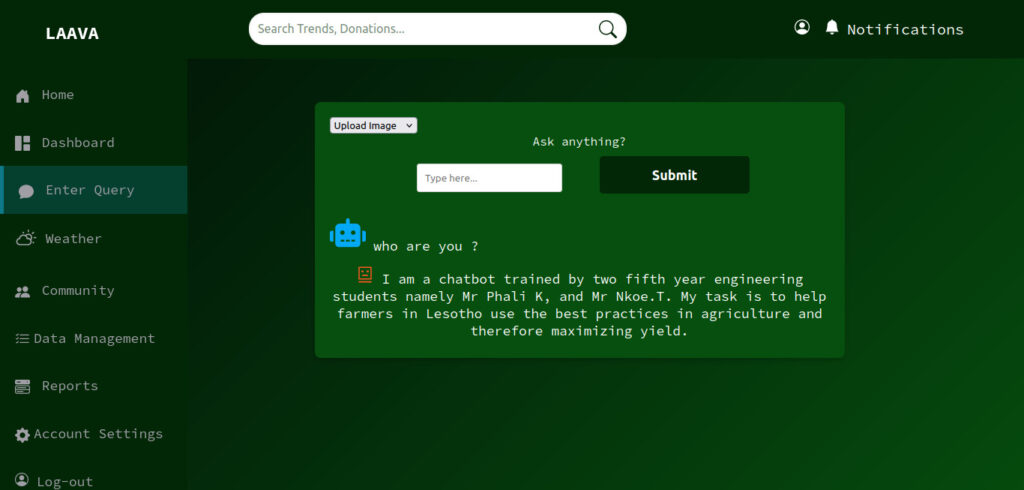
TN: The goal was to create a user-friendly system that leverages AI to diagnose crop diseases and guide farmers in Lesotho. We saw a need for a technology solution that could address the challenges faced by Basotho farmers.
PK: The initial inspiration came from the observation that agriculture is the backbone of Lesotho’s economy, yet many farmers lack access to crucial information and resources. We saw an opportunity to bridge this gap by creating an AI language model that could provide real-time, relevant information in Sesotho, helping farmers make informed decisions and improve their productivity.
Can you describe your vision for this project and what you hope to achieve with it?
TN: Our vision is for LAAVA to become a comprehensive agricultural support system for Basotho farmers. We hope to see LAAVA not only diagnose diseases but also optimize cultivation practices and maximize yields.
PK: Our vision for this project is to empower farmers across Lesotho by providing them with a reliable, accessible, and culturally relevant AI assistant. We hope to achieve a significant impact in the agricultural sector by enhancing communication, providing timely advice, and ultimately improving the livelihoods of farmers. We also aim to set a precedent for the development of AI solutions in other African languages.
3. Technical Aspects and Development:
Could you explain the technical aspects of your AI language model? How does it work, and what technologies are you using?
TN: LAAVA utilizes a chat-based system. Farmers upload an image of their crop, and the AI analyzes the image to identify potential diseases. The system is equipped with machine learning that allows it to continuously learn and improve its accuracy over time.
PK: The AI language model we’ve developed leverages natural language processing (NLP) techniques to understand and respond to queries in Sesotho. We are using machine learning algorithms to train the model on a dataset of agricultural terms and scenarios specific to Lesotho. Our technology stack includes Nodejs for the backend, React with Vite for the frontend, and various AI tools to enhance the model’s accuracy and efficiency.
What challenges have you faced in developing this model, and how have you overcome them?
TN: One challenge was training the model to accurately identify diseases in various crops. We addressed this by acquiring a vast amount of data and images. Another challenge was incorporating Sesotho language support. We are actively working on improving LAAVA’s understanding of Sesotho.
PK: One of the primary challenges was the limited availability of digital resources in Sesotho, which made it difficult to train the model effectively. We overcame this by collaborating with local linguists and agricultural experts to create a comprehensive dataset. Another challenge was ensuring the model’s accuracy in understanding and processing the nuances of Sesotho, which required continuous testing and refinement.
4. Impact on Agriculture:
How do you see your AI language model in Sesotho impacting the agricultural sector in Lesotho?
TN: LAAVA has the potential to revolutionize agriculture in Lesotho by enabling early disease detection, improved resource allocation, and increased yields. Farmers can make informed decisions based on LAAVA’s insights.
PK: Our AI language model has the potential to revolutionize the agricultural sector in Lesotho by providing farmers with easy access to vital information in their native language. This can lead to better crop management, more efficient use of resources, and ultimately, higher yields. The model can also serve as a tool for educating farmers about best practices and new technologies, fostering a more informed and resilient farming community.
Can you share some specific examples or scenarios where your model could significantly benefit farmers?
TN: For instance, LAAVA can guide strawberry farmers on maintaining optimal moisture and temperature levels for proper growth. It can also assist tomato farmers in identifying diseases like early blight and recommend appropriate remedies.
5. Cultural and Linguistic Significance:
Why is it important to develop technology in Sesotho, and what cultural significance does it hold for you?
TN: Developing technology in Sesotho bridges the digital divide and ensures that all Basotho farmers have access to critical information in their native language. This fosters cultural inclusion and empowers Basotho communities.
PK: Developing technology in Sesotho ensures that our language remains vibrant and relevant in the modern world. It also empowers our community by making technology accessible to those who might not be fluent in other languages, preserving our cultural identity and heritage.
How do you ensure that your AI model accurately understands and processes Sesotho, given its nuances and complexities?
TN: We are continually training LAAVA on Sesotho text data and working with experts to ensure it understands the language’s nuances. The more users interact with LAAVA in Sesotho, the better it will become at understanding and responding.
PK: We ensure accuracy by incorporating a diverse dataset and collaborating with Sesotho linguists to fine-tune the model. Continuous testing and feedback loops are integral to refining the model’s understanding of context, idioms, and regional dialects.
6. Market and Community Engagement:
How are you planning to market your AI language model to farmers and the broader agricultural community?
TN: We plan to collaborate with agricultural organizations and extension workers to reach out to farmers. We will also explore using mobile phone technology to make LAAVA widely accessible.
PK: We plan to market the model through partnerships with local agricultural organizations, community outreach programs, and leveraging radio and social media platforms popular among farmers. Demonstrations at local events and word-of-mouth will also play key roles.
Have you engaged with local farmers or agricultural organizations during your development process? If so, what feedback have you received?
TN: Yes, we have received valuable feedback from farmers and agricultural organizations during development. This feedback has helped us refine LAAVA’s functionalities and user interface to better suit the needs of Basotho farmers.
7. Sustainability and Future Plans:
What are your plans for ensuring the sustainability and scalability of this project?
TN: We are seeking collaborations with government entities, NGOs, and private organizations to secure funding for LAAVA’s ongoing development and maintenance. Additionally, we are exploring incorporating monetization features in the future to ensure sustainability.
PK: To ensure sustainability, we plan to continuously update the model with new data and expand its capabilities. We also aim to secure partnerships and funding from agricultural stakeholders to support ongoing development and scaling to other regions.
Are there any future developments or additional features you are planning to incorporate into your AI model?
TN: We plan to expand LAAVA’s disease identification capabilities to encompass a wider range of crops.
PK: Future developments include integrating weather data, real-time market prices, and expanding the model’s capability to cover more crops and farming techniques. We also plan to add voice recognition to make it even more accessible.
8. Collaboration and Support:
Have you received any support or collaboration from government entities, NGOs, or private organizations for your project?
TN: We have been fortunate to receive support from Internet Society Lesotho for recognizing our project and helping us to network with some giants in the industry. Their contributions have been invaluable in advancing our project.
PK: We are in discussions with several entities for potential collaborations. While we haven’t secured formal partnerships yet, the interest and support from the community have been encouraging, and we are optimistic about future collaborations.
How can individuals or organizations interested in your work get involved or support your initiative?
TN: Individuals and organizations can support LAAVA by providing financial contributions, offering technical expertise, or assisting with data collection and analysis. They can also help spread awareness about the project and its potential impact.
PK: Individuals or organizations can get involved by offering expertise, funding, or resources. We welcome collaborations for expanding our dataset, improving the model, or spreading awareness. They can reach out to us through our website or social media channels.
9. Personal Reflections:
What has been the most rewarding aspect of working on this AI language model?
TN: Seeing the potential of LAAVA to improve the lives of Basotho farmers has been incredibly rewarding. Knowing that our work can contribute to a more sustainable and prosperous agricultural sector is truly fulfilling.
Can you share any personal stories or experiences that have particularly influenced or motivated you during this journey?
TN: My passion for technology, particularly in developing AI systems, ignited during my third year of study. Alongside my friend Mr. Phali, I envisioned an AI-powered solution to assess fruit quality in the marketplace. Our goal was to empower consumers to select the most flavorful and nutritious apples by simply analyzing their visual attributes.
10. Call to Action:
What message would you like to share with the readers of Selibeng.com about the importance of technology in agriculture?
TN: Technology has the power to transform agriculture and improve the livelihoods of farmers. By embracing innovation, we can create a more sustainable and resilient food system.
PK: Technology is a powerful tool that can revolutionize agriculture, especially in a country like Lesotho. Embracing it can lead to better crop yields, sustainable farming practices, and improved livelihoods. I encourage everyone to be open to these innovations.
How can people stay updated on your progress and get in touch with you for more information?
TN: People can follow our progress on
- 1. Facebook: Tshepang Nkoe
- 2. LinkedIn: Tsepang Nkoe
- 3. WhatsApp: +266 5776 705.
- 4. Email at [email protected].
PK: People can follow our progress on
- 1. Contacts: +266 6261 1696
- 2. Email: [email protected]
11. Final Thoughts:
Is there anything else you would like to share about your project, your journey, or your vision for the future?
Tsepang Nkoe: We believe that LAAVA has the potential to become a leading agricultural support system in Lesotho and beyond. We are committed to continuous improvement and expansion of the project. We invite everyone to join us in this journey towards a more sustainable and prosperous agricultural future.
Phali Khotso: I would just like to emphasize that this project is about more than just technology—it’s about preserving our culture, empowering our people, and building a brighter future for Lesotho. We are excited about what lies ahead and welcome any support or collaboration.